Why it matters
- Transformer availability depends on specialised materials as well as final assembly. A domestic insulation line could strengthen a less visible part of Canada's electricity infrastructure supply chain.
- The project creates a new industrial destination for wood fibre. Electrical-grade pressboard links Canada's forest products base to higher-value grid equipment rather than treating forestry and electrification as separate markets.
- The federal release explicitly identifies manufacturing technologies and automation. That creates a credible area for industrial capability research, while actual control systems, quality inspection architecture and suppliers remain undisclosed.
The new capability is insulation materials, not complete transformer assembly
The federal government and Hitachi Energy both announced the project on October 16, 2026. They describe Canada's first electrical-grade pressboard manufacturing capability. The intended products are pressboard and laminated insulation materials used in high-voltage transformers. This is a materials manufacturing investment; it should not be read as a new London factory assembling complete transformers.
Hitachi Energy explains that insulation quality and consistency support transformer electrical performance, reliability and cooling. The company identifies specialised insulation availability as one of the constraints facing transformer manufacturing. Bringing that production closer to North American customers could improve supply resilience, although the announcements do not quantify a reduction in delivery times or prove that the wider transformer shortage will be resolved.
The funding figures describe one project with distinct public contributions
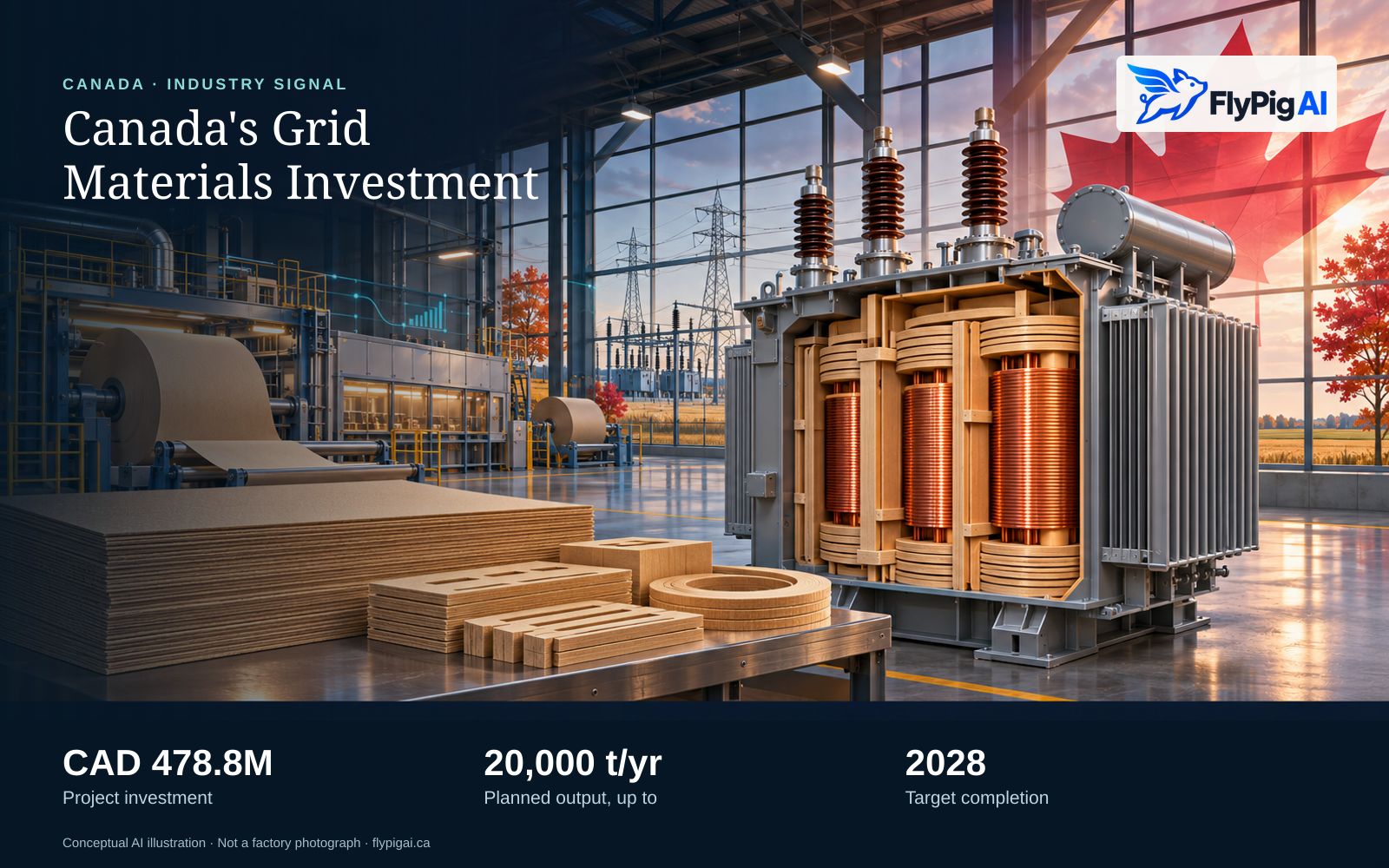
Innovation, Science and Economic Development Canada gives the project value as CAD 478.8 million. Hitachi Energy's release uses the rounded figure CAD 479 million. These are consistent descriptions of the same investment, not two separate projects. All amounts in this article are Canadian dollars.
Federal support totals CAD 30 million: CAD 20 million through the Strategic Response Fund and CAD 10 million through the Investments in Forest Industry Transformation program. The company's release also reports up to CAD 20 million from Ontario's Invest Ontario Fund. These contributions should be kept separate from the project value rather than added together to announce a larger investment total. The public releases do not provide a complete expenditure or disbursement schedule.
Planned capacity and jobs still depend on execution
The government says the facility is intended to turn wood fibre into up to 20,000 tonnes of electrical-grade pressboard and laminated insulation materials each year. Hitachi Energy describes a planned 21,000-square-metre facility, expected to be completed by 2028 and to create more than 100 permanent skilled jobs. These are project targets and expected benefits, not evidence that output, commissioning or hiring has already been delivered.
The federal release also refers to Hitachi Energy growing its Canadian workforce from approximately 1,250 to 1,765 employees. That is a broader Canadian workforce commitment and must not be described as more than 500 new jobs at the London plant. For the new facility itself, the stated local expectation is more than 100 jobs. The next useful execution evidence would be construction progress, equipment commissioning and qualification of saleable material.
The government identifies Hitachi Energy's transformer operations in Varennes, Quebec, as an intended destination for the materials, alongside other transformer and insulation manufacturers in North America and global markets. This establishes a proposed industrial connection, but it does not disclose customer allocation, contracted tonnage or the share of output that will remain in Canada.
The technology opportunity is in the process, controls and quality evidence
For Canadian industrial integrators, the announcement is worth following because it names both a manufacturing process and an intended output. The federal source explicitly mentions advanced manufacturing technologies and automation. Process monitoring, industrial computing, control, power systems and inspection are therefore reasonable categories to investigate. The releases do not identify the equipment bill of materials, control platform, inspection method, system integrator or a deployed AI application.
Taiwan's industrial electronics ecosystem can be mapped against those categories, but a meaningful match would require actual operating requirements. Examples of questions for a future equipment specification include which properties must be measured, how material consistency is documented, what interfaces connect instruments and controls, and what service and reliability obligations apply. Those are FlyPig AI's engineering questions, not requirements already issued by Hitachi Energy.
The project should also be distinguished from direct demand for AI chips. Data centres and electrification are part of the demand context cited by the official sources, but this investment concerns transformer materials. Any opportunity for edge computing or machine vision would arise through the factory's eventual process architecture and qualification decisions, rather than automatically from electricity demand growth.
FlyPig AI interpretationCanada's grid build-out has an industrial materials layer. The London project matters because it connects wood fibre, specialised insulation production and transformer manufacturing in a defined investment program. For technology suppliers, the practical task is to follow commissioning and process requirements until a real equipment or integration need becomes visible. The announcement supports capability research; it does not yet define an accessible procurement opportunity or a supplier award.
Status, open questions and Canada relevance
Current product status
The October 16, 2026 first-party releases establish an announced, government-supported project. Hitachi Energy targets completion by 2028; the federal release gives planned capacity of up to 20,000 tonnes annually. The reviewed material does not establish an operating production line, commissioning date, qualified output, equipment supplier selection or Taiwan sourcing. This article is a November editorial analysis of the October announcement, not a new commissioning report.
What remains open
- What construction, equipment installation and commissioning milestones will be disclosed before the 2028 completion target?
- How will the facility qualify material consistency and transformer-grade performance before commercial supply?
- Which automation, process-control and inspection requirements or equipment integrators will become public?
- How will output be allocated between Varennes, other Canadian customers and export markets?
Why Canadian teams may care
The project connects Ontario manufacturing and Canadian forest-product inputs to the transformer supply chain, including an intended link to Varennes, Quebec. Canadian integrators can track process and commissioning needs; Taiwan suppliers can research relevant industrial capabilities while awaiting disclosed specifications and procurement paths.