Why it matters
- A claimed deployment across 20 factory lines creates a more concrete discussion than an architecture-only demonstration, though independent line coverage is unverified.
- Industrial agent orchestration requires machine constraints, operator permissions, event logs and fallback behavior; model quality is only part of deployment readiness.
- Reported output gains should be evaluated using controlled baselines, operational costs and system boundaries rather than copied as generalized AI benchmark performance.
An internal deployment claim, with limits
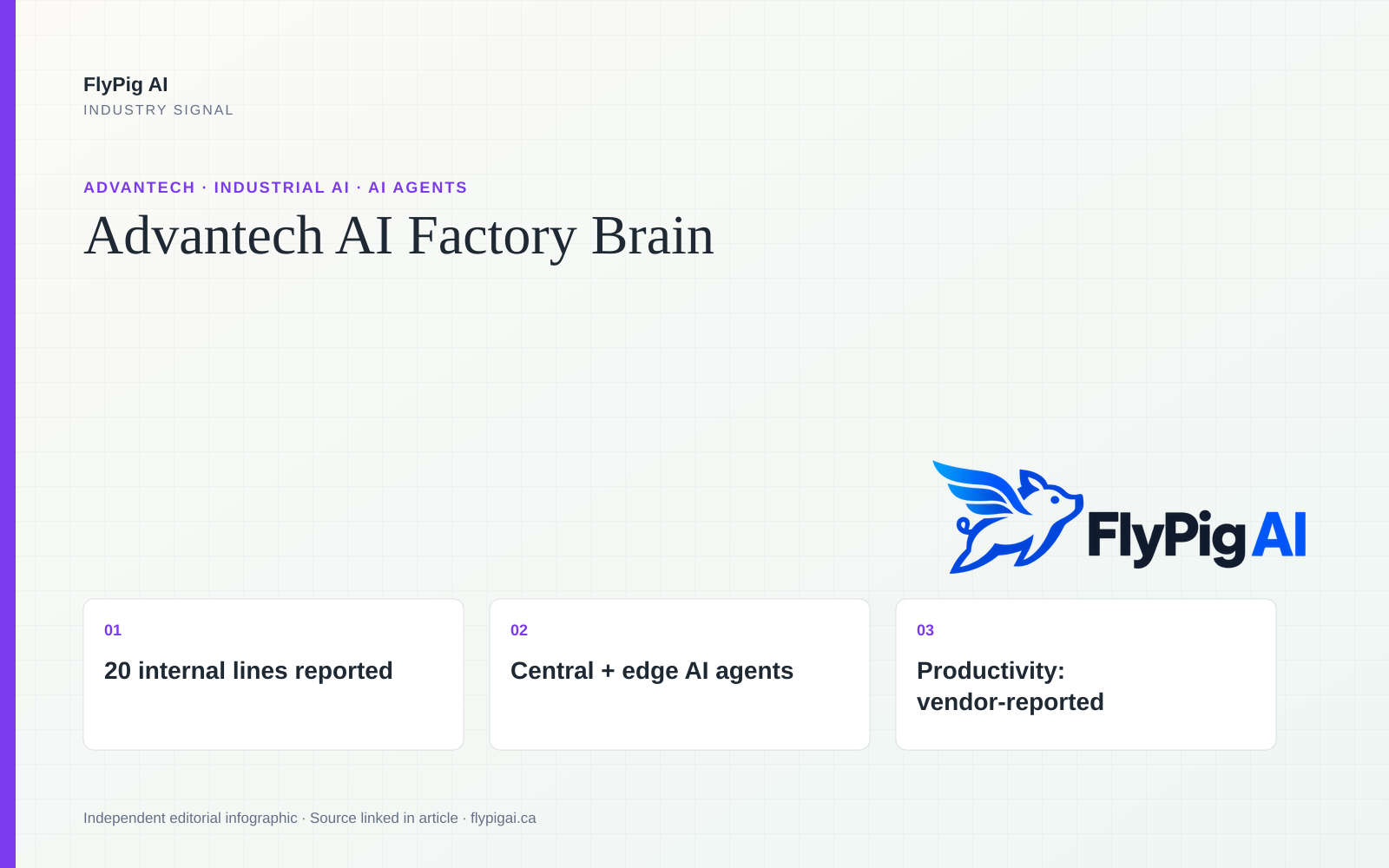
Advantech's October 2026 report described AI Factory Brain as a combination of Central, Simulation and Edge AI Agents deployed over 20 internal manufacturing lines. It also identified NVIDIA-related components supporting parts of the overall architecture. This is evidence of a concrete company announcement about an operating environment, not independent verification of exactly how each line is covered.
An Advantech executive reported third-quarter output per employee rising 13.2 percent against the preceding quarter, alongside an 8.91 percent improvement associated with five agents. Those are internally reported observations with no public matched control group, task breakdown or adjustment for changing production mix in the reviewed release. They should not be presented as a validated causal return on investment for AI agents.
Agentic software must respect industrial authority
Factory AI can help organize maintenance tickets, planning and quality analysis while leaving machine motion and safety interlocks with deterministic controllers. Moving from advice to unattended actions is a separate engineering decision. Product teams need a permission model, human approval thresholds, reversible actions, identity management, secure OT connectivity and audit trails. A generative agent's ability to formulate a plan cannot itself authorize a change to physical equipment.
The central-versus-edge division is important for Canadian manufacturers with intermittent connectivity or strict safety rules. Local controllers should retain bounded operation when cloud services fail. Simulation output should be tested against factory conditions before applying it to a live workcell. None of those safeguards can be inferred from a headline about agent count or deployment scale.
What a fair commercial evaluation needs
An integrator evaluating this architecture should ask which functions each agent performs, where recommendations require approval and how failures are handled. Performance studies should measure machine uptime, throughput, scrap, operator intervention, licensing and maintenance cost using a consistent time window. The October announcement does not establish general commercial software pricing or a production-ready package with a fixed scope.
FlyPig's reading is that industrial AI vendors are moving toward whole-operation orchestration narratives. That is strategically important for Physical AI, but evidence should be scored by independently observable workflow outcomes and governance, not by counts of models, lines or marketing case studies.
FlyPig AI interpretationA self-reported 20-line footprint is a useful signal of operational ambition. The real differentiator will be reliable task-specific results under clearly enforced machine and operator boundaries.
Status, open questions and Canada relevance
Current product status
Advantech says AI Factory Brain is deployed across 20 internal production lines. Independent evidence for the performance figures and standalone product access or pricing was not established.
What remains open
- Which line-level workflows were actually automated, and where were operator approvals, logs and rollback enforced?
- Can published output changes be reproduced with independent baselines that account for production mix, staffing and maintenance costs?
Why Canadian teams may care
A reference point for Canadian factories and industrial system integrators assessing bounded AI-agent orchestration rather than open-ended machine autonomy.