Why it matters
- A swallowable imaging device imposes a tight combined energy budget on sensing, data processing and wireless transmission.
- The company-reported manufacturing target is more specific than a concept demonstration, but it is not confirmation of an available medical system or chip.
- NMPA-related statements must be checked against device-specific records before being repeated as a regulatory clearance claim.
A reported manufacturing milestone for a constrained camera
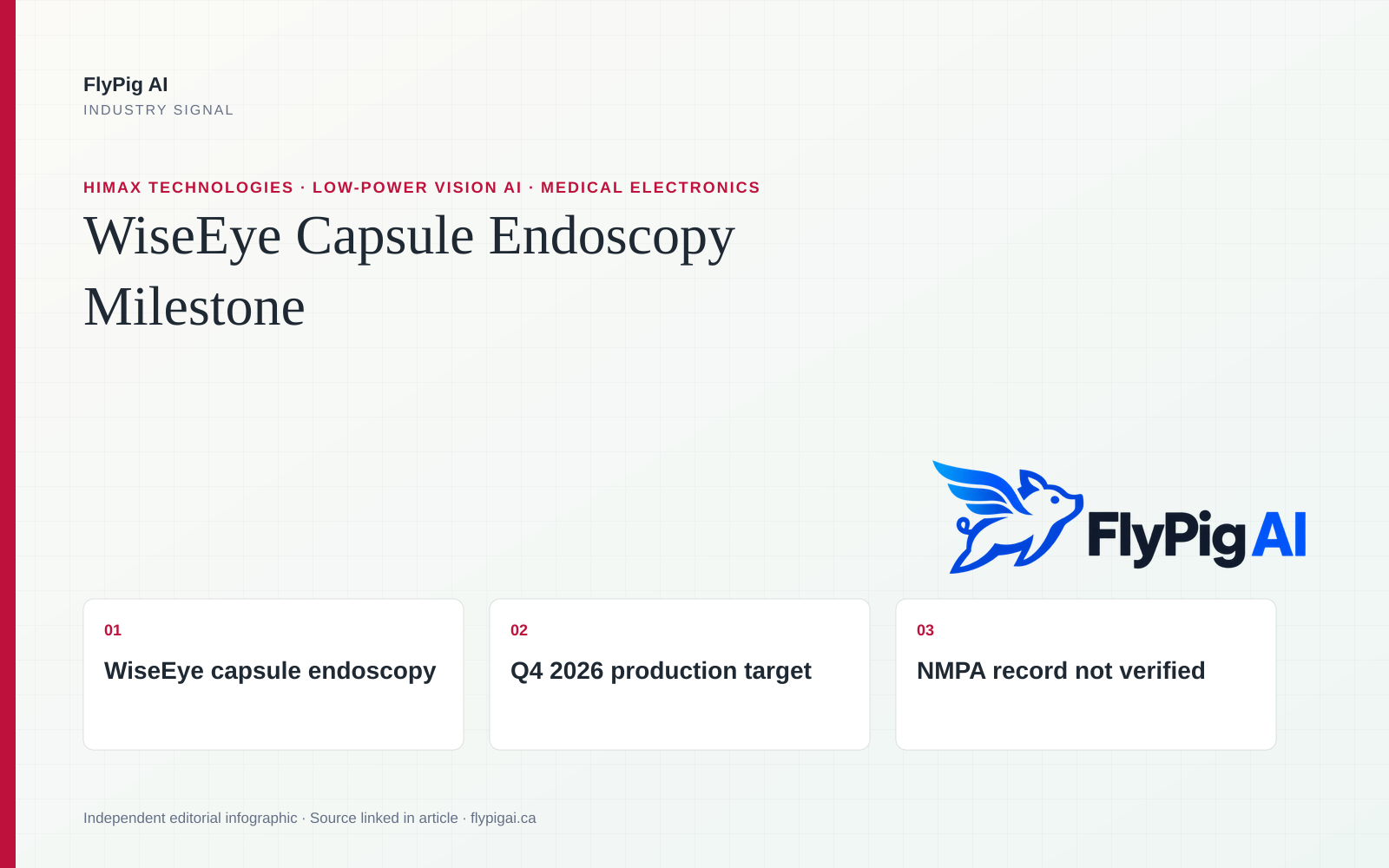
Himax discussed its WiseEye low-power visual sensing technology in capsule endoscopy during a November 5 third-quarter financial-results announcement. According to the company, the approach supports a swallowable imaging device that captures and transmits visual data. Himax said one project involving a device for human examinations is slated to start mass production in the fourth quarter of 2026.
The earnings release also refers to an extended review and approval process under China's National Medical Products Administration Class III medical-device framework. It does not identify a registration certificate number, final device brand, manufacturer or model in that passage. The statement therefore supports reporting what Himax says about its process, but is not independent verification of the device's particular approval status. No claim about Canadian authorization follows from it.
Power and imaging trade-offs go well beyond the AI processor
A capsule endoscope has much less space for energy storage and heat dissipation than a conventional camera module. Image capture, illumination, local preprocessing, memory traffic, compression and radio transmission have to be treated as one electrical and mechanical system. An efficient vision engine may help, but the finished device's runtime and image quality depend on the full design and its operating profile.
The source does not provide a tested power budget, battery capacity, image resolution, optical details, frame rate or radio throughput for the named project. It also does not disclose any independent clinical diagnostic data. Describing this as a new application direction is justified; suggesting proven patient outcomes or superiority over a specific clinical procedure is not established by the supplied technical evidence.
Do not confuse guidance, clearance and shipment
The phrase 'slated to enter mass production this quarter' is forward-looking. It is not a statement that a manufacturing line has completed qualification or that a finished product has reached hospitals. Himax has not named the customer, component ordering code, volume commitments or a procurement channel for other OEMs. Any such interpretation would go beyond the announcement.
An engineering team assessing the low-power technology would need device-specific power measurements, supported host interfaces, image-sensor operating limits and manufacturing data. A medical-device company would separately have to validate the precise NMPA registration and applicable jurisdictional requirements. The defensible insight is that Himax has announced a concrete production target in a demanding visual-sensing niche.
FlyPig AI interpretationThe reported Q4 production target suggests WiseEye is being considered for exceptionally constrained imaging hardware. FlyPig would treat it as a platform-learning signal, not a medical-product recommendation, until the named device, regulatory documentation and manufacturing start are independently confirmed.
Status, open questions and Canada relevance
Current product status
Himax reports a Q4 2026 production target for one human-health capsule-endoscopy project. The specific model, independent NMPA record, shipment start, pricing and component availability have not been verified.
What remains open
- Which device model and legal manufacturer correspond to the project, and what NMPA certificate can be independently checked?
- What WiseEye component, camera configuration, battery budget and transmission architecture were qualified, and has production actually started?
Why Canadian teams may care
Canadian developers of low-power sensing systems may investigate the architecture, but a company's account of Chinese medical-device review does not establish Health Canada authorization or a directly purchasable module.