Why it matters
- Combining display timing and driving functions may change component count and integration effort in robot HMI subsystems.
- A claimed production milestone is a stronger commercial stage than a demo, but unnamed customers and undisclosed shipments limit confidence.
- No exact TED SKU, panel configuration, volume, pricing or availability can be derived from the earnings release.
A reported stage change, not a new display-chip launch
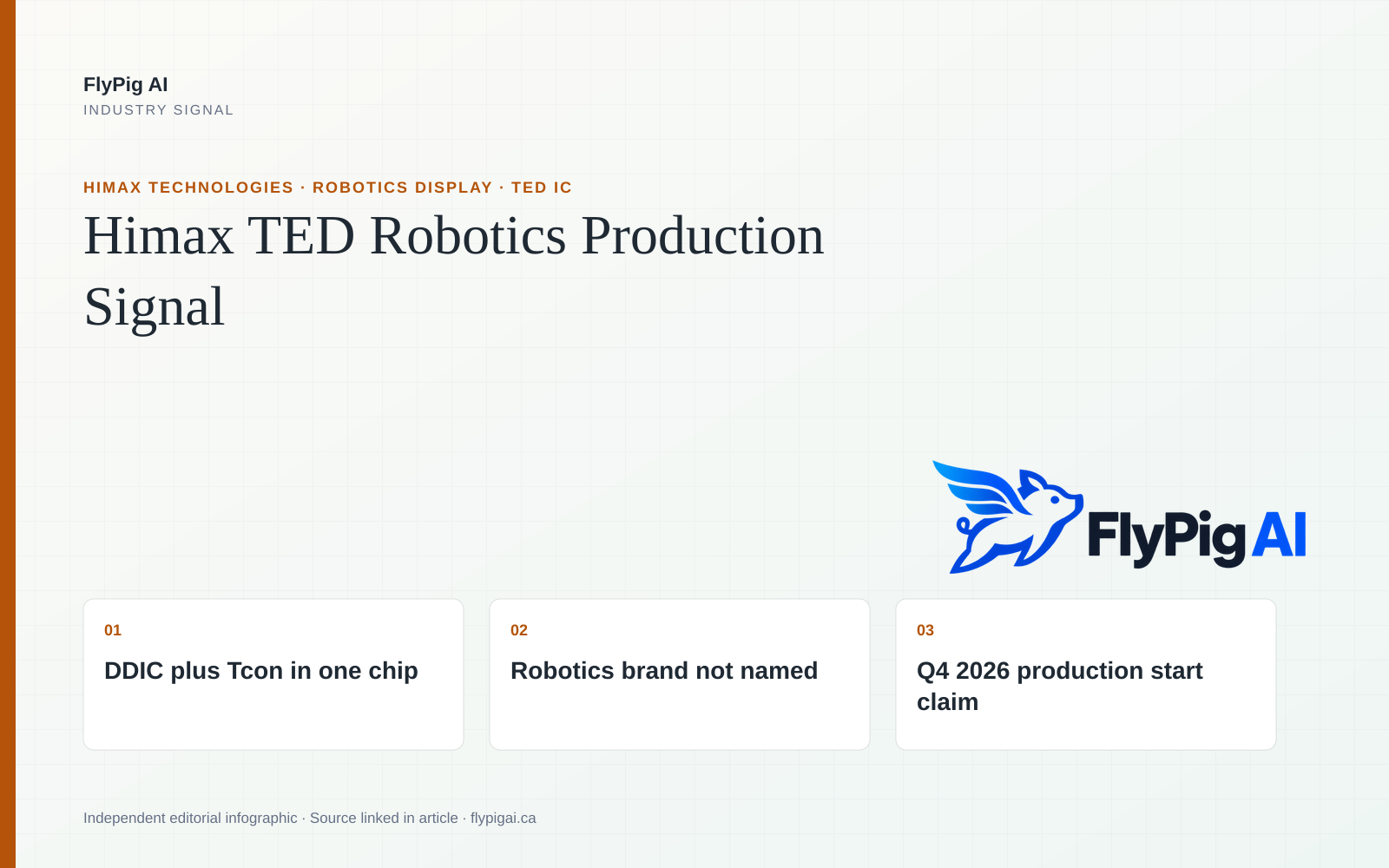
Himax Technologies used its November 5, 2026 earnings statement to report progress for TED, its Tcon Embedded Driver IC technology. TED combines display-driver and timing-controller functions in one chip and has previously been discussed for smaller automotive and other display applications. The company said a first robotics mass-production milestone had been reached with a leading global brand, with production commencing in Q4.
The significant new point is the claimed production stage of one application, not the first disclosure of TED as a technology. Himax did not name the robotics company, model, display panel, chip ordering code or production facility. No independent customer announcement or shipping record was identified in the reviewed source, so those facts remain unverified.
Robot interfaces create a narrow but relevant design opportunity
Physical AI machines often include an operator screen, diagnostic display or service interface. Integrating display timing and driving circuitry may reduce parts or simplify layout for some panel types, depending on electrical interfaces, resolution, thermal constraints and lifecycle requirements. It does not establish system-wide energy savings or an off-the-shelf module without a matched design.
For Canadian robotics and industrial-equipment OEMs, display subsystem selection is not merely cosmetic. Qualification, spare-parts planning, maintenance access and long-term source stability matter alongside the visual interface. A supplier's reported production program may justify requesting a technical review, but it does not create a verified commercial source for a new customer.
Production language needs care
The earnings release says production is commencing in the fourth quarter of 2026. This should not be retold as an already completed shipment or as proof of a revenue contribution from a named customer. Himax separately mentions other automotive design wins, which are not evidence that those projects use the same robotics configuration.
Engineering teams need a part-specific datasheet, panel and timing support, driver initialization details, voltage and temperature limits, sample access, ordering conditions and a supply-longevity commitment. Commercial teams should withhold customer and volume attributions until disclosed. The immediate intelligence value is knowing that TED has reportedly moved beyond its evaluation-only stage in at least one robotics program.
FlyPig AI interpretationTED now deserves attention in the robot HMI subsystem stack, but the real design-in decision needs a disclosed part number and compatible panel. FlyPig treats the anonymous customer and shipment story as unresolved rather than converting it into a named design win.
Status, open questions and Canada relevance
Current product status
Himax reports a robotics production milestone with Q4 2026 production commencing. A specific customer, actual shipment quantities, availability and TED ordering parts are unconfirmed.
What remains open
- Which TED device and display interface underpin the reported robotics program?
- Has production actually begun and shipped, and which samples, panel qualifications and procurement channels can other OEMs access?
Why Canadian teams may care
Canadian robotics makers can monitor TED for compact operator interfaces, but should demand a qualified display stack and confirmed sourcing before selecting a component.