Why it matters
- Physical AI systems require synchronized, context-rich observations of real environments; reliable camera and sensing hardware may become a distinct product layer alongside robot controllers.
- Data fidelity, calibration and traceability can determine whether collected robot demonstrations are useful for model training or safety investigations.
- A forecast of first revenue in 2027 is a commercialization signal, not evidence of current volume orders or a broadly available catalog product.
The development is a data pipeline, not a new robot chipset
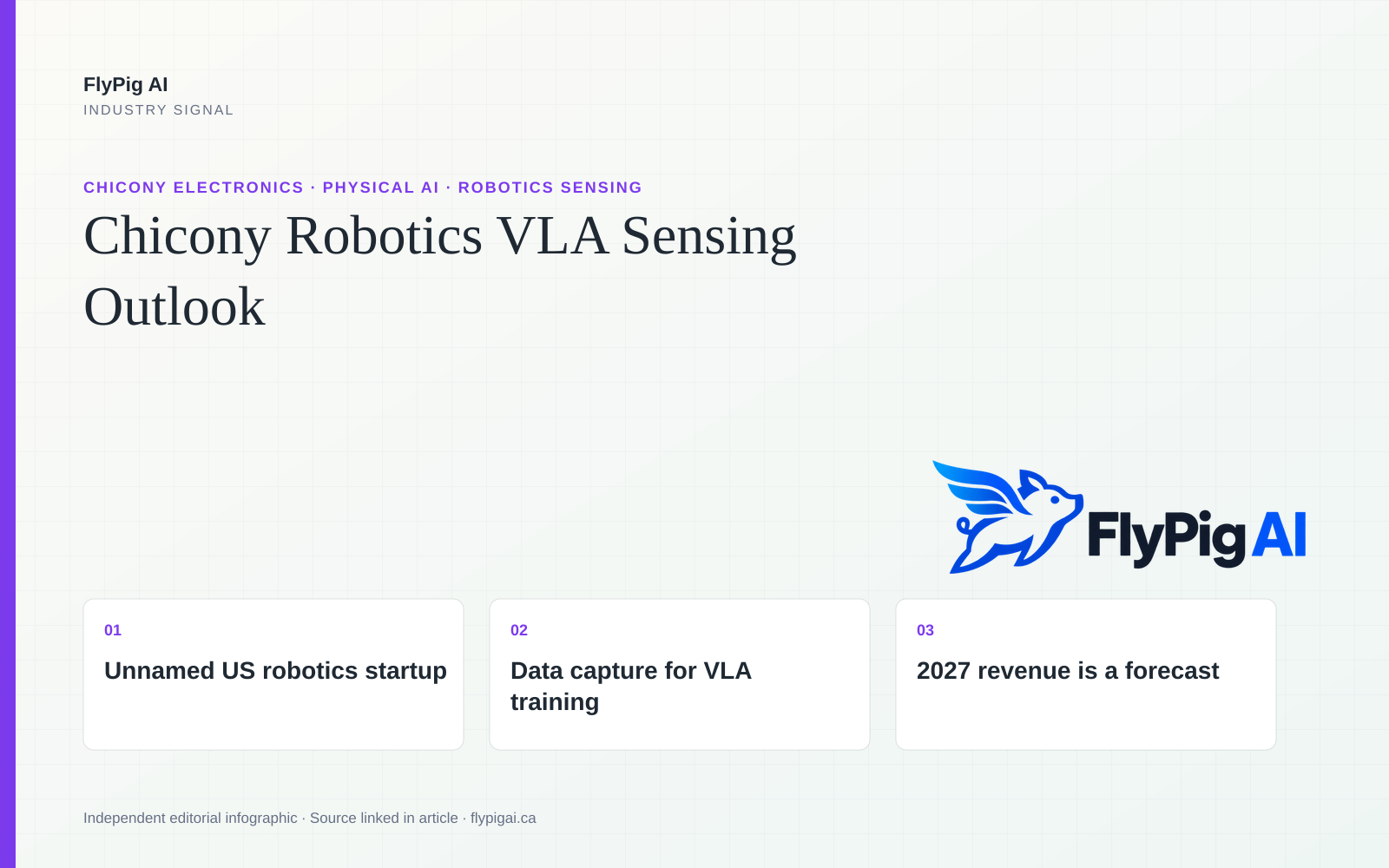
Chicony used its November 11, 2026 quarterly-results announcement to describe customized image capture and underlying data-collection work with a US robotics startup that it did not name. It said the solution combines vision-language models with multi-sensor learning and supports the collection of environmental perception and movement data for subsequent vision-language-action model training. The description adds technical detail to an earlier disclosed robotics collaboration; it should not be mistaken for a first partnership announcement.
The manufacturer's account is specific about the intended function but not the implementation. It does not identify an image-sensor model, camera count, time-synchronization method, processor, data format or a named customer. Those omissions matter: dataset quality is not inferred from generic statements about using multiple sensors or AI. The publisher has not independently tested the system or verified the extent of deployment.
Why training-data hardware can matter to physical AI
A robot policy may require information that ordinary video recording does not capture well: alignment of cameras and other sensors, accurate timestamps, robot action labels, calibration history and reliable handling of dynamic scenes. An OEM that offers repeatable capture subsystems could help reduce the custom engineering needed to assemble such data. That is a potential commercial value proposition rather than a confirmed specification of Chicony's unreleased solution.
For design teams, the relevant architectural questions concern sensor bandwidth, image quality in variable lighting, synchronization error, local storage, data protection and the division of work between an edge device and an offline training stack. Inference hardware and data-collection hardware are not interchangeable. A solution built for gathering demonstrations may be inappropriate for low-power field inference without further engineering.
A 2027 revenue target is not an order book
Chicony stated that commercialization and technical verification work was progressing and expected this robotics-related imaging category to contribute initial revenue in 2027. That wording does not establish volume production, signed orders, design-win value, shipment quantities or the customer's identity. The earlier collaboration and the new training-data focus are both company-reported. The financial release offers no independently checkable commercial milestones for this individual project.
Canadian robotics developers and research integrators should separate potential supplier competence from verified procurement readiness. The practical follow-up is to request supported sensor configurations, APIs, calibration procedures, export and data-ownership terms, sample access, NRE requirements and a pilot acceptance test. A roadmap becomes a design option only when the implementation can be evaluated on an actual task.
FlyPig AI interpretationChicony's announcement points to a useful distinction: Physical AI needs hardware that creates trustworthy training data as well as hardware that runs trained policies. The opportunity is credible as a market direction, but the specific solution remains a company-described development rather than a qualified, orderable design route.
Status, open questions and Canada relevance
Current product status
Chicony reports customized robotics sensing and training-data work under technical and commercial validation. It expects initial revenue in 2027. Model numbers, shipment status, pricing, volume production, customer identity and purchasing channels are undisclosed.
What remains open
- What camera and sensor combinations, timestamping accuracy, calibration tools and data formats can the solution demonstrably support?
- Can external OEMs evaluate the subsystem independently, and under which licensing, data ownership, NRE and manufacturing terms?
- What externally verifiable milestone would distinguish a planned 2027 contribution from actual orders or delivery?
Why Canadian teams may care
Canadian robotics OEMs and labs building embodied-AI training pipelines may have reason to track Taiwan imaging ODM capabilities, but should not infer Chicony's system is available for procurement.