Why it matters
- Fleet operations become a major cost driver after an AI camera, robot controller or gateway leaves the lab.
- Grouped OTA and remote diagnostics could reduce site visits if deployments include safe staging, rollback and failure recovery.
- Remote SSH and image distribution also expand cyber risk; references to TPM or device identifiers do not prove security for an entire fleet.
What the supplier is offering
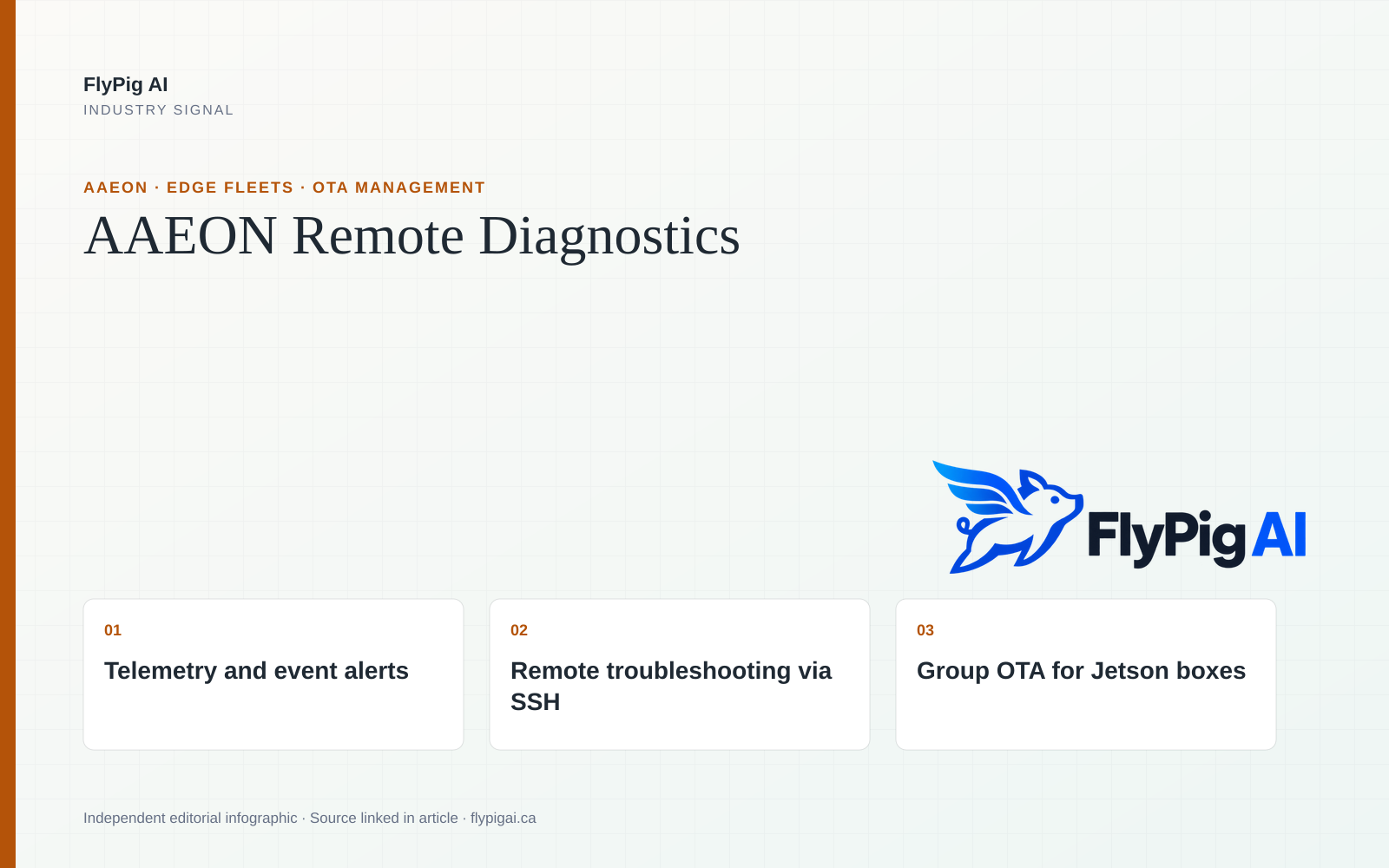
AAEON's October 22 product news describes a web portal for viewing CPU and GPU utilization, temperature, memory and storage conditions on connected devices. It also mentions configurable thresholds, email and SMS alerts, service logs, remote SSH connections and Group OTA updates for selected Jetson-based box PCs. The company says a free download is available from relevant product pages; the precise license and cloud-hosting arrangement were not confirmed in the reviewed material.
This is a fleet-maintenance software announcement, not a new chip or evidence that every AAEON platform has identical remote-management support. AAEON conditions some recovery features on out-of-band functionality or compatible wake-on-LAN hardware. A product team should ask how the management server is deployed and whether the update tool can cope with heterogeneous device versions.
An update system is also a security-critical system
The operational value becomes obvious when a remote camera or inspection node fails after a software release. Engineers need to know the last good image, whether an update is digitally signed, how to stage deployments and how to roll back without visiting the site. Data bandwidth, intermittent links, storage limits and a mixture of hardware revisions all affect success, regardless of whether a dashboard supports an attractive Group OTA button.
AAEON refers to UUID-based authentication and TPM-backed key storage. Those are possible building blocks, not evidence of a third-party security assessment or an end-to-end secure update protocol. Remote SSH must be scoped by least privilege, credentials need revocation and audit logs must survive unexpected failures. Device telemetry can also raise residency and privacy questions for operators.
What Canadian OEMs should verify
A serious proof of concept should include interrupted power, blocked network access, a bad image, an expired signing key and a deliberate rollback. Ask AAEON for supported models and software versions, image-format requirements, server and network architecture, API access, security-update commitments and any subscription or hosted-service charges.
The design lesson for FlyPig is that competitive Edge AI platforms increasingly include the operations layer. Fleet maintainability deserves the same weight as TOPS, price and sensor I/O when comparing hardware candidates, especially for remote Canadian deployment locations.
FlyPig AI interpretationField maintenance determines whether a strong prototype becomes a durable product. Group OTA is a valuable capability only when secure signing, staged updates and recovery have been tested in the target fleet.
Status, open questions and Canada relevance
Current product status
Announced October 22, 2026. AAEON reports a free-download tool and Jetson support, but exact supported SKU combinations, license, service commitments and production deployment status remain unconfirmed.
What remains open
- Which Jetson box SKUs, BSP versions and OTA image formats are supported, and what constitutes a tested rollback path?
- How are remote access, device authentication, logging, hosting, data privacy and long-term security patches governed?
Why Canadian teams may care
Relevant to remote Canadian Edge AI camera and gateway fleets where reliable remote service can be as important as inference performance.